MoreExam
1. Question Content...
EXPLANATION
Answer: X - EXPLANATION Content.
Question1: Which TCP/IP stack can support management traffic, vSphere vMotion, IP storage and vSphere Fault Tolerance? (Choose the best answer.)
Question2: An administrator wants to ensure that when virtual machines (VMs) are powered on, Distributed Resource Scheduler (DRS) places them on the best-suited host. When the cluster becomes imbalanced, the administrator wants DRS to display recommendations for manual VM migration.Which DRS automation level should the administrator select? (Choose the best answer.)
Question3: In a vSphere High Availability (vSphere HA) cluster, which condition can be detected by datastore heartbeating? (Choose the best answer.)
Question4: An administrator wants to be able to log in to the vSphere Client and view the inventories of two vCenter Server instances.What must the administrator do to meet this requirement? (Choose the best answer.)
Question5: An administrator would like to make virtual machine templates and ISO images available to all vCenter Server instances in the data center.Which feature should the administrator use to achieve this goal? (Choose the best answer.)
Question6: What is a minimum disk controller requirement for VMware vSAN? (Choose the best answer.)
Question7: What can an administrator use to partition limited CPU and memory resources between two departments?(Choose the best answer.)
Question8: Which two statements are true regarding the use of firmware update packages in vSphere Lifecycle Manager?(Choose two.)
Question9: A recently deployed set of test virtual machines are impacting the performance of a company development team project datastore. The shared cache server appears to be suffering from storage congestion.Storage I/O Control is already enabled on all company datastores.Which two steps should the administrator take to improve the performance of the cache server? (Choose two.)
Question10: A single host is manually configured to company standards.Which option would an administrator select to capture this configuration for future use? (Choose the best answer.)
Question11: Which feature can an administrator use for site availability with minimal effort and a low recovery point objective (RPO)? (Choose the best answer.)
Question12: An administrator wants to be able to send vCenter Server log files to a remote syslog server and analyze logs using vRealize Log Insight.Which step must the administrator take to meet this requirement? (Choose the best answer.)
Question13: An administrator needs to configure Proactive High Availability (HA) in a vSphere environment so that virtual machines (VMs) do not run on any partially degraded hosts. The administrator would also like to see the recommendations before VMs are migrated.Which automation and remediation level should the administrator select? (Choose the best answer.)
Question14: An administrator is running a variety of vSphere 6.5 cluster configurations and is tasked with upgrading to vSphere 7.0.Which two conditions could cause potential conflicts or outages to the virtual machines (VMs)? (Choose two.)
Question15: A company has a vSphere environment consisting of the following characteristics:* A content library named 'CORP' is published at corporate headquarters on a vCenter Server named'vcenterCorp'.* A regional data center contains a set of hosts managed by a vCenter Server named vcenterR1.* vcenterR1 subscribes to the CORP content library.The administrator wants to create a new virtual machine image to use on vcenterR1. What are two possible ways the administrator can accomplish this task? (Choose two.)
Question16: An administrator runs a two-node vSphere cluster, which contains two domain controller virtual machines (VMs). The administrator wants to ensure that VMs run on separate hosts without interfering with normal maintenance operations.How should the administrator configure Distributed Resource Scheduler (DRS)? (Choose the best answer.)
Question17: An IT department is experiencing random hardware failures that are costing the company money. The CIO is looking for technical support beyond traditional break/fix with enhanced visibility and proactive insights into the environment at no additional cost.Which VMware service meets the needs of the CIO? (Choose the best answer.)
Question18: How does vSphere handle memory allocation during the instant clone process? (Choose the best answer.)
Question19: How many vSphere Trust Authority Clusters can a Trusted Cluster reference? (Choose the best answer.)
Question20: An administrator can attach a baseline to which two inventory objects? (Choose two.)
Question21: An administrator is tasked with upgrading an existing VMware vSphere 6.5 environment to version 7.0. There are existing VMFS3 and VMFS5 datastores in the environment.Which two statements are true regarding this upgrade? (Choose two.)
Question22: An administrator is tasked with upgrading an existing vSphere environment to version 7.0. There are existing VMFS3 and VMFS5 datastores in the environment.Which statement is true regarding this upgrade? (Choose the best answer.)
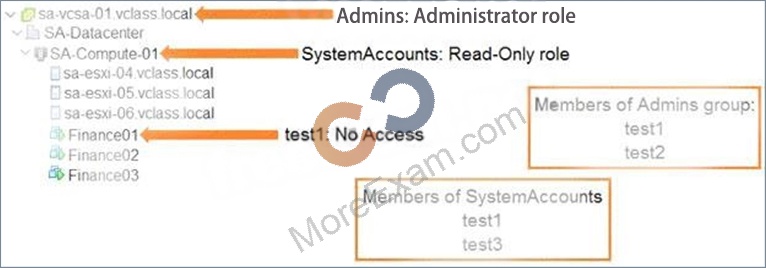
Question23: Refer to the exhibit.What is the effective role the test1 account has on the Finance01 virtual machine? (Choose the best answer.)
Question24: Refer to the exhibit.An administrator is consistently receiving an alarm regarding a CPU performance issue; however, there is NO CPU issue identified.What can the administrator do to make sure the alarm is triggered when there is an actual CPU performance issue? (Choose the best answer.)